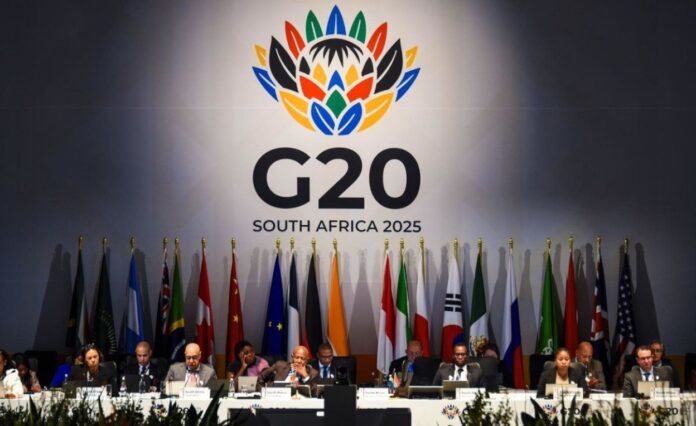

The United States has reversed its earlier decision and confirmed it will participate in this weekend’s G20 summit in Johannesburg, President Cyril Ramaphosa announced Thursday, marking an 11th-hour shift ahead of the first-ever Africa-hosted meeting of leading economies.
President Donald Trump’s administration had earlier said it would not attend the November 22-23 meeting, warning that no final statement by G20 leaders could be issued without its presence. Tensions arose this year over various international and domestic policies, extending to Pretoria’s G20 priorities for the first-ever Africa-hosted summit of leading economies.
“We have received notice from the United States, a notice which we are still in discussions with them over, about a change of mind about participating in one shape, form or other in the summit,” Ramaphosa told reporters.
“This comes at the late hour before the summit begins. And so therefore, we do need to engage in those types of discussions to see how practical it is and what it finally really means,” he added.
There was no immediate confirmation from US officials. Ramaphosa emphasized, “We still need to engage with them to understand fully what their participation at the 11th hour means and how it will manifest itself.”
Earlier, in a note to the government on Saturday, the US embassy had reiterated that it would not attend the summit, citing South Africa’s G20 priorities, which it said “run counter to the US policy views and we cannot support consensus on any documents negotiated under your presidency.”
Ramaphosa insisted Thursday that South Africa would not be bullied. “It cannot be that a country’s geographical location or income or army determines who has a voice and who is spoken down to,” he said at a G20 curtain-raiser event. “There should be no bullying of one nation by another.”
He described the apparent US change of heart as “a positive sign,” adding, “All countries are here, and the United States, the biggest economy in the world, needs to be here.”
Under South Africa’s presidency, the summit carries the theme “Solidarity, Equality, Sustainability.” Its agenda focuses on strengthening disaster resilience, improving debt sustainability for low-income countries, financing a “just energy transition,” and harnessing “critical minerals for inclusive growth and sustainable development.”
After early objections from Washington, South Africa vowed to press on with its programme, aiming to find consensus on a leaders’ statement. “We will not be told by anyone who is absent that we cannot adopt a declaration or make any decisions at the summit,” Foreign Minister Ronald Lamola said Thursday.
Trump has targeted South Africa on multiple fronts since returning to the White House in January, including debunked claims of white Afrikaners being systematically “killed and slaughtered,” the expulsion of South Africa’s ambassador in March, and the imposition of 30 percent trade tariffs—the highest in sub-Saharan Africa.
US businesses were well represented at a separate Business 20 (B20) event in Johannesburg, which concluded Thursday. The head of the US Chamber of Commerce, Suzanne Clark, thanked South Africa for fostering “real collaboration between G20 nations during a time of rapid change” and said, “The US Chamber of Commerce will use our B20 leadership to foster international collaboration.”
The United States maintains significant business interests in South Africa, with more than 600 US companies operating in the country, according to the South African embassy in Washington. G20 members collectively account for 85 percent of global GDP and around two-thirds of the world’s population.